Home-country mutations count fully
If your active operator mutates on your own country, it counts toward country score, HashBeast rewards, and MVP credit.
The Country Race turns many one-minute Casino Rolls into a bigger country result. During the race, players bet, claim, mutate HashBeasts, and push country score. When the economy reaches its LP-burn boundary, countries settle as Climb, Hold, or Fall.
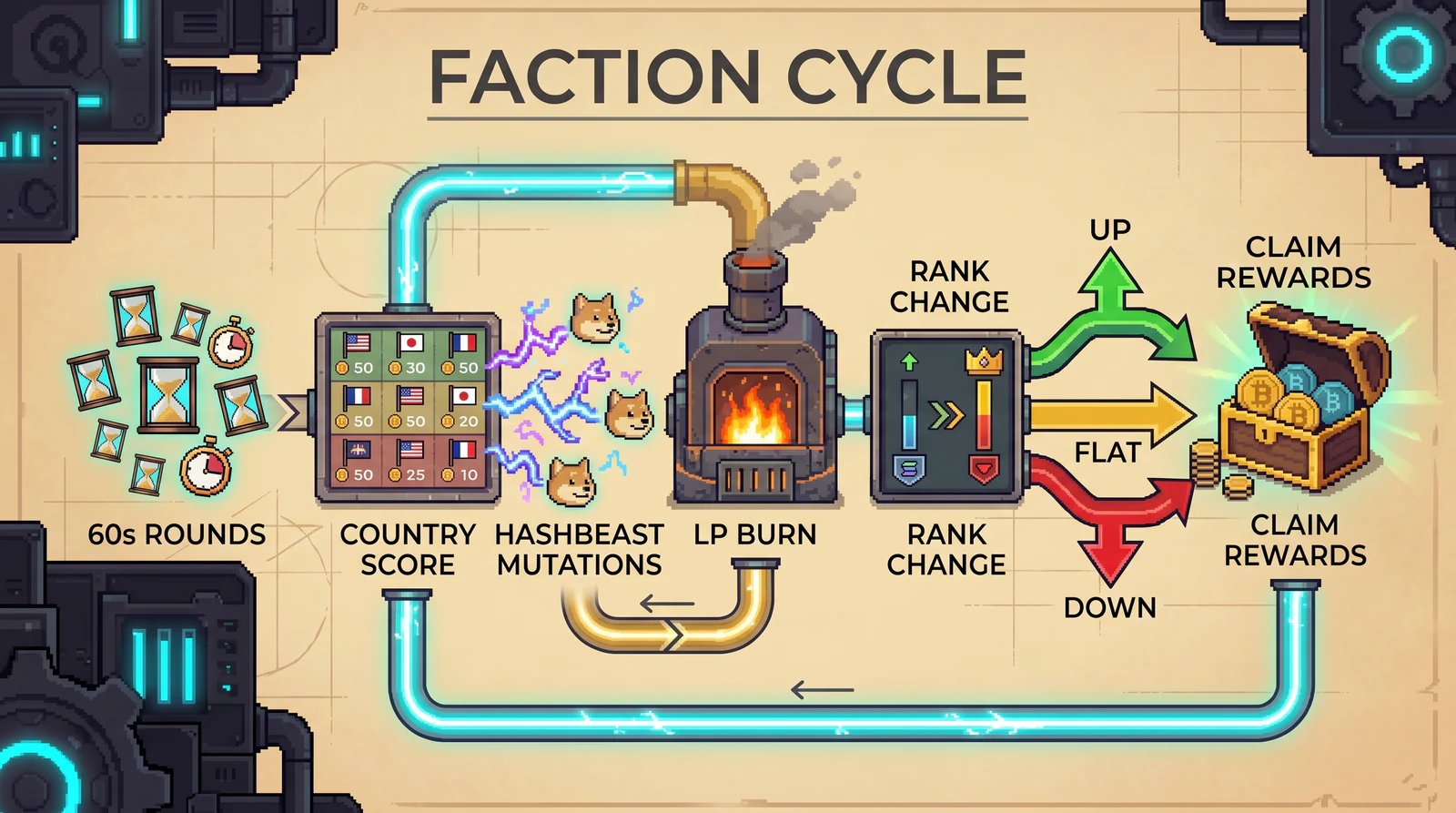
A Country Race lasts roughly four hours: eight 30-minute price snapshots. The important boundary is the economy's LP add-and-burn step. That connects country wars to buybacks, permanent liquidity, and the wider MineBTC economy instead of letting the leaderboard float on its own.
Anyone can initialize the active Country Race before Casino Rolls feed into it.
Each 60-second roll records country, move, weighted points, and SOL volume.
Winning home-country claims can create HashBeast mutations and country score.
The economy adds liquidity, burns LP, and captures the boundary roll.
Final ranks lock, Climb/Hold/Fall resolves, and Country Race reward claims open.
Bets create Country Race exposure. Claims create most of the interesting pressure. A resolved win with an active HashBeast can roll XP, multiplier growth, mutation, country score, and MVP credit.
When the Country Race settles, each country's final rank is compared with its previous rank. Your own-country race exposure pays the base lane only if you called that final move correctly.
Your country finished higher than its prior-race rank.
Your country held the same rank. The contract direction is Flat/Neutral.
Your country finished lower than its prior-race rank.
Mutations are the strongest country-score events, so the contract paces them. The roll is shaped by correctness, active multiplier, country volume, per-round mutation pressure, and whether the race is ahead of or behind target.
Current tuning targets 12 mutations across roughly 240 Casino Rolls, with a 20% base chance, 0.25% floor, 25% cap, and pacing adjustments when the race is ahead or behind target.
After the boundary roll is processed, anyone can settle the Country Race. Settlement computes final ranks, resolved directions, reward pools, MVPs, residuals, and SOL mirror rewards, then opens race claims.
Those settled ranks become the starting line for the next Country Race. The next race begins from real prior performance, so every country gets a fresh Climb / Hold / Fall target.
Each settled race is also a chapter of Hashiden, the AI live show: 42 races make a one-week season, and the beasts that earned events in the race become the chapter's cast.